

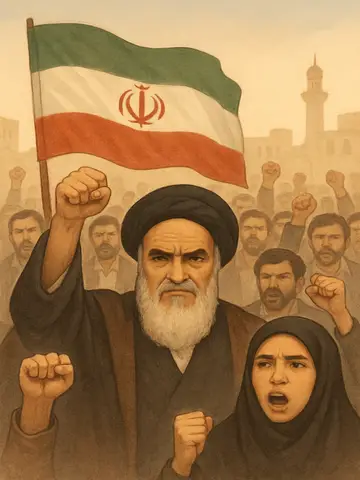
The Iranian Revolution of 1979 represents a major turning point in the contemporary history of the Middle East. This revolution led to the fall of the Shah Mohammad Reza Pahlavi monarchy and the establishment of an Islamic republic led by the Ayatollah Khomeini. This upheaval was not only political but also cultural and social, reflecting decades of popular discontent and internal tensions. Understanding the historical context and impacts of this event is essential to capture the region's current dynamics.
Historical context of the 1979 Iranian Revolution
The Iranian Revolution is part of a context of deep discontent with Shah's authoritarian regime, perceived as corrupt and too Westernist. Since Shah's modernising reforms in the 1960s and 1970s called the White Revolution, many Iranians have felt a loss of their traditional values and economic exclusion. At the same time, the political repression was particularly severe, particularly with the action of the SAVAK, the secret police that muzzled any opposition. Social discontent intensified, bringing together various groups, from the working class to the religious, who saw in the Ayatollah Khomeini as a figure capable of restoring Iranian identity and sovereignty. This climate of tension culminated in 1978-1979 with massive protests that forced the Shah to stomp and allowed Khomeini to regain power.
The political and social consequences after 1979
After the victory of the revolution, Iran underwent a radical transformation of its political system. The monarchy was replaced by an Islamic republic based on a theocracy in which the Shiite clergy held supreme authority. This new governance has profoundly changed the country's institutions, legislation and international relations, including through a break with the United States. At the social level, the revolution strengthened conservative religious values, which had an impact on women's rights, individual freedoms and culture. However, it has also generated a strong nationalist feeling and a desire for autonomy in the face of foreign interference. The ensuing internal and external tensions shaped Iranian policy for the following decades, making 1979 a pivotal date in the country's history.
The 1979 Iranian Revolution remains a founding event that continues to influence not only Iran, but also the entire Middle East. By overthrowing a monarchy imposed by the West and establishing an Islamic republic, this upheaval redefined the place of religion in politics and caused profound social transformations. To understand Iran's contemporary challenges, it is crucial to return to this time when popular aspirations have taken on a new and radical form, changing the face of the country forever.