


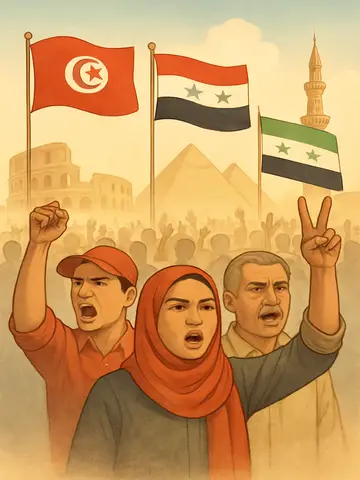
The 2011 Arab Spring represents a series of popular uprisings that have shaken several countries in the Arab world, including Tunisia, Egypt and Syria. These movements have been motivated by a quest for freedom, dignity and social justice, as well as by the rejection of authoritarian regimes in place for decades. This upheaval marked a crucial step in the contemporary history of these nations, illustrating both the hope for change and the complexity of political transitions.
Origins and outbreak of the Arab Spring in 2011
The root causes of the Arab Spring are multiple: endemic poverty, high unemployment, widespread corruption, lack of political freedoms and brutal repression. In Tunisia, the trigger was the immolation of Mohamed Bouazizi, a young street salesman, in December 2010, a desperate act in the face of injustice and marginalization. This act inflamed minds and triggered a wave of protests that quickly spread to other countries, including Egypt and Syria. Social networks have played a key role in mobilizing people, facilitating the exchange of information and organizing demonstrations.
Impact and consequences in Tunisia, Egypt and Syria
In Tunisia, the Arab Spring led to the fall of President Zine el-Abidine Ben Ali, paving the way for an exemplary democratic transition in the region, with free elections and a new constitution adopted in 2014. In Egypt, the uprising led to the resignation of Hosni Mubarak, but the post-revolutionary period was marked by political instability, with a return to an authoritarian regime under Abdel Fattah al-Sissi. Syria, for its part, experienced a dramatic escalation: what had begun as peaceful demonstrations turned into a devastating civil war, causing a heavy human and humanitarian crisis. These contrasting trajectories reflect the complexity of the challenges facing Arab societies in search of profound change.
The Arab Springs have profoundly disrupted the region and revealed the strength of popular aspirations for freedom and justice. While some countries such as Tunisia have managed to start a democratic transition, others, such as Syria, remain plunged into violence and instability. Their complex and sometimes painful legacy continues to shape the Middle East and inspire the struggles for emancipation around the world.