


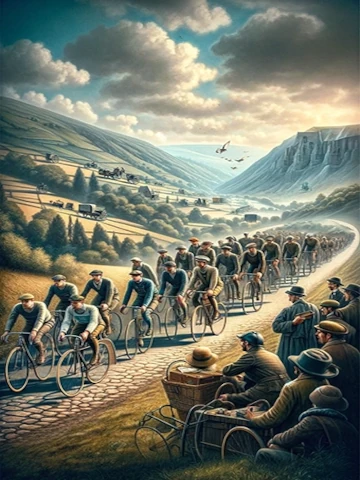
The Tour de France, today one of the world's largest cycling competitions, owes its origins to a bold initiative launched in the early twentieth century. The first edition, held in 1903, marked the beginning of a sporting adventure that would captivate millions of spectators across the globe. This race, born of an editorial challenge, laid the foundation for a now mythical event.
Birth of the Tour de France: a cycling challenge unreleased in 1903
The idea of the Tour de France was born in the offices of the newspaper « Auto » in 1903, then in full competition with « The Bike ». In order to boost the sale of his newspaper, Henri Desgrange, director of « Auto », imagined a cycling race around France, a new challenge that promised to test the endurance of the riders over exceptional distances. This visionary project brought together amateur and professional cyclists ready to face harsh conditions, with the aim of travelling nearly 2,400 kilometres in six stages. The birth of the Tour was therefore the result of a mixture of commercial strategy and sporting passion, giving rise to a competition of a magnitude never seen before.
The milestones of the first edition of the Tour de France
The first edition of the Tour de France took place from 1 to 19 July 1903, with six long and challenging stages, often at night, linking key cities such as Paris, Lyon, Marseille, Toulouse, Bordeaux and Nantes. Among the highlights, the victory of racer Maurice Garin, who dominated the race with impressive regularity, remains emblematic. Each stage was a real endurance test in difficult conditions, with unpaved roads and rudimentary equipment. This first edition also revealed the magnitude of the physical challenge, especially during the third stage between Marseille and Toulouse, where fatigue began to be felt among the participants. These moments forged the legend of the Tour and showed that this race would be much more than just a sporting competition.
The first edition of the Tour de France in 1903 laid the foundation for an event that would become a symbol of French and world sport. More than just a race, she embodied a human and technological challenge, uniting passion, endurance and a spirit of competition. Since this first edition, the Tour has ceased to evolve, but it still retains the pioneering spirit that made its reputation from the beginning. Today, the Tour de France remains an essential event, celebrating each year the history and the greatness of cycling.