

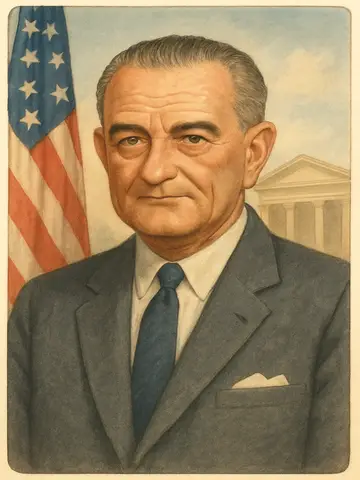
1963 marks a major turning point in US political history with Lyndon B. Johnson's accession to the presidency. Following a tragic event, Johnson inherits a deeply divided country facing complex social, economic and international challenges. Its entry into office is both sudden and crucial, laying the foundations for its future mandate and ambitious reforms.
Lyndon B. Johnson joined the presidency in 1963
On November 22, 1963, in Dallas, President John F. Kennedy was murdered, causing a huge shock across the country and the world. As Vice President, Lyndon B. Johnson was immediately invested in the United States President, taking an oath on board the Air Force One aircraft, in an atmosphere of great tension. His accession to power was marked by the need to reassure a grieving nation and ensure the continuity of government. Johnson, an experienced politician from Texas, must quickly impose himself on doubts and expectations, while asserting his authority in a delicate political context.
Lyndon B. Johnson's first challenges after Kennedy
As soon as he took office, Lyndon B. Johnson faced major challenges. At the domestic level, it must manage civil rights tensions, while the movement for racial equality is growing and violence is breaking out in several regions. Internationally, the Cold War remains a constant threat, with the missile crisis in Cuba still fresh in memory. Johnson also faces the need to continue the economic and social reforms initiated by Kennedy. His ability to navigate in these troubled waters will define his presidency and allow him to launch what he will call the « Large Company »a set of policies aimed at reducing poverty and improving the living conditions of Americans.
Lyndon B. Johnson's accession to the presidency in 1963 was a decisive moment for the United States, marked by a rapid transition and immediate responsibility. In the face of multiple challenges, Johnson quickly affirmed himself as a determined leader, laying the foundation for a presidency that would profoundly influence the country's social and political history. His role after Kennedy remains a striking illustration of resilience and continuity in times of crisis.