

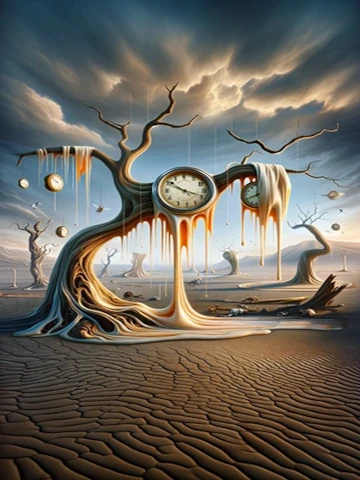
« The Persistence of Memory, » painted in 1931 by Salvador Dalí, is one of the most emblematic works of surrealism. This fascinating painting, with its soft watches that seem to melt in a dreamy landscape, questions time, reality and human perception. Through this creation, Dalí invites the spectator to plunge into a universe where the classical laws of logic are shaken, offering a profound reflection on the fluidity of time.
The Master of Salvador Dalí in 1931
In 1931, Salvador Dalí realized « The Persistence of Memory, » a canvas that has become a real symbol of the surreal movement. This work, of a modest size, immediately captures attention by its contrast between realistic objects and fantasy elements. Dalí depicts a desert landscape, typical of the region of Catalonia from where it originates, on which rests several soft, distorted and stretched watches as if they melted under an invisible heat. This painting, first exhibited in New York, marked a turning point in Dalí's career, making him an undisputed master of surrealism and an innovator of modern painting.
Analysis and Meaning of the Persistence of Memory
The analysis of « The Persistence of Memory » reveals a complex meditation on the nature of time and memory. Soft watches symbolize the relativity of time, an idea influenced by the theories of modern physics and subjective perception of events. The desert landscape, calm and still, contrasts with the deformation of objects, suggesting that time is not a fixed reality but a fluctuating experience. The presence of a strange and amorphous figure in the centre could be a representation of the dream or unconscious, reinforcing the psychological aspect of the work. Dalí thus uses paradoxical images to explore the boundaries between real and illusion, between past and present.
« The Persistence of Memory » remains a captivating work that continues to fascinate with its visual audacity and symbolic depth. By breaking the traditional conventions of time and space, Salvador Dalí opens a door to a world where memory and reality are confused. This painting is not only an artistic feat, but also an invitation to rethink our own perception of time and existence. With its originality and power, it remains an essential centrepiece of 20th century art.