

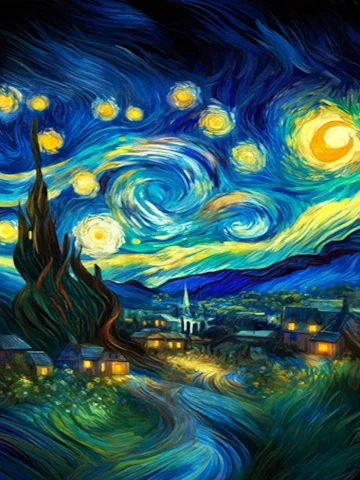
The Starry Night, painted in 1889 by Vincent van Gogh, is probably one of the most emblematic masterpieces in art history. This captivating work, with its dynamic whirlwinds and vibrant colours, transcends the simple night landscape to express a deep emotion and a unique vision of the world. In this article, we will explore his artistic analysis and the historical and symbolic context surrounding this magnificent canvas.
Artistic analysis of The Starry Night, 1889
The Starry Night is remarkable for its post-impressionist style characterized by vigorous brush strokes and whirlpool shapes that animate the night sky. Van Gogh uses an intense palette of colours, dominated by deep blues and bright yellows, creating a striking contrast between night and glittering stars. The circular motion of stars and clouds evokes an almost palpable energy, as if the sky itself were in perpetual motion. The composition is orchestrated so as to direct the gaze towards the large black cypress, which rises in the foreground and seems to link the earth to the cosmos. Through this technique, Van Gogh manages to transmit not only the beauty of a starry night, but also a sensation of wonder and introspection.
Historical context and symbolism of the work
Made in June 1889, La Nuit étoilee was painted while Van Gogh was interned at the asylum of Saint-Rémy-de-Provence, a difficult period marked by psychological disorders. This personal context profoundly influences the interpretation of the work: the whirlwind sky can be seen as a projection of the tumultuous emotions of the artist. Moreover, the peaceful village below, although imagined, brings a contrasting stability, perhaps symbolizing hope or refuge. Cypress, often associated with death in the Mediterranean tradition, could also represent a bridge between earthly life and the Hereafter, strengthening the spiritual dimension of the canvas. The Starry Night thus goes beyond the simple landscape to become a visual meditation on life, nature, and the mystery of the universe.
The Starry Night remains a poignant testimony of Van Gogh's genius, combining bold technique with intense symbolic depth. This work continues to inspire generations of artists and lovers of art, inviting everyone to contemplate not only the beauty of the night sky, but also the complex nuances of the human soul. Exploring its luminous whirlwinds, one discovers a universe where art and life intertwine with strength and emotion.