


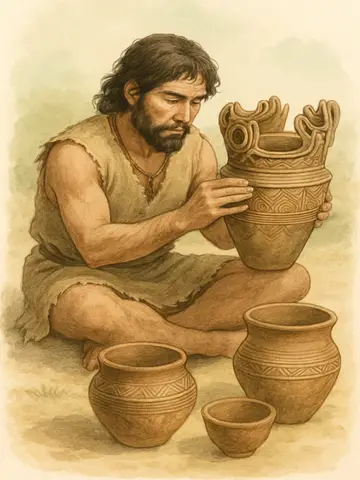
The art of pottery Jomon bears witness to one of Japan's oldest ceramic traditions, dating back about 1400 B.C.E. This prehistoric period, marked by a semi-nomadic lifestyle and great artistic creativity, left a fascinating cultural heritage through its unique pottery. These objects are not only valuable archaeological witnesses, but also remarkable works of art that reveal the technical and aesthetic skills of ancient Japanese.
Art of Jomon pottery in ancient Japan around -1400
Around -1400, the Jomon culture was at its peak in the Japanese region. The pottery produced at that time reflected a very elaborate art, with complex patterns and various forms. These pottery were mainly used for cooking, storage or rituals, and their manufacture was in deep respect of natural cycles. Jomon pottery is often decorated with relief decorative motifs, obtained by the printing of strings, where the name « Jomon », which literally means « String motifs ». These creations reveal an impressive artistic sensitivity as well as a great mastery of terracotta.
Techniques and distinctive styles of Jomon ceramics
The main technique that characterizes the Jomon pottery is the use of strings wrapped around still soft clay, creating unique relief patterns. In addition to this decoration technique, Jomon artisans also mastered hand-modeling and low-temperature cooking. Styles vary by region and period, ranging from simple and functional pots to more sophisticated works with spiral ornaments, zigzag or anthropomorphic shapes. This diversity reflects an evolving know-how and a rich culture, where the practical usefulness of objects was combined with artistic expression deeply rooted in daily and spiritual life.
Jomon pottery, dating from about -1400, remains an exceptional window on ancient Japan, illustrating a culture that combined functionality and aesthetics with great finesse. Their study continues to enrich our understanding of the early inhabitants of the Japanese archipelago, as well as artistic techniques that have influenced future generations. These thousand-year-old objects are not only archaeological remains, but also living witnesses of creativity and know-how that persist in the history of Japanese art.