


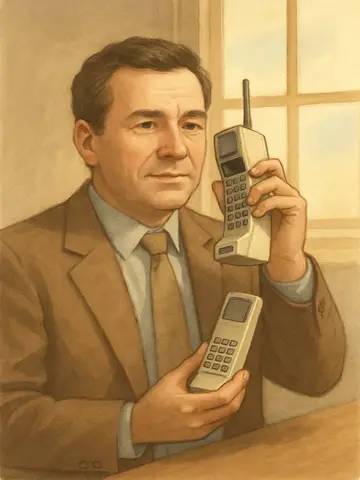
The invention of mobile phones in 1973 marks a crucial step in the history of communication technologies. This moment has paved the way for a revolution that has transformed the way people interact, work and live on a daily basis. Back to this major invention and its lasting impacts.
Revolutionary invention of mobile phone in 1973
In 1973, Martin Cooper, an engineer at Motorola, made a technological feat by making the first mobile phone call from a mobile device. This phone, known as Motorola DynaTAC, was large and weighed close to one kilogram, but it represented an unprecedented advance. Unlike fixed phones, this mobile phone allowed wireless communication, freeing the user from the constraints of traditional telephone lines. This invention laid the foundations of modern cellular networks and paved the way for the era of mobile communication, which was rapidly going to prevail worldwide.
How the first mobile changed our communications
The appearance of the mobile phone has profoundly changed the way people communicate. Prior to this invention, telephone conversations were limited to fixed infrastructure, reducing mobility and accessibility. With the mobile phone, it has become possible to stay connected permanently, wherever it is. This has had a considerable impact on professional and personal life, facilitating rapid exchanges, instant organisation and even emergency management. Today, although the devices are much more sophisticated, the fundamental principle introduced in 1973 continues to influence our hyper-connected world.
The invention of mobile phones in 1973 by Martin Cooper was a real technological revolution that forever changed our modes of communication. This simple device, heavy and rudimentary in its beginnings, initiated a transformation whose effects are visible in every aspect of our daily life. The mobility and connectivity it has made possible remain at the heart of our way of life, reflecting the historical importance of this innovation.