


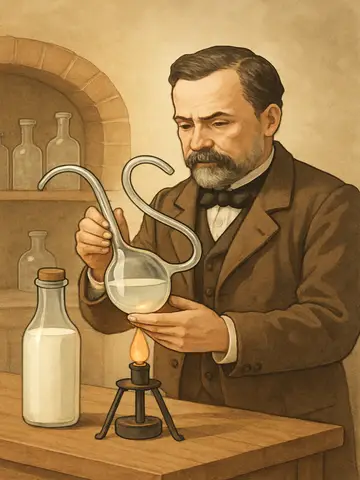
In the mid-19th century, Europe made major advances in science and medicine, but diseases of microbial origin remained poorly understood. The industrial revolution is changing urban lifestyles, increasing hygiene and public health problems. In this context, contamination of food, particularly milk and wine, poses a significant health risk.
Scientific and social context before the discovery of 1864
Before 1864, the theory of miasms prevailed, explaining diseases by « bad smells » rather than micro-organisms. Microbiology is still in its infancy, despite the first observations of microbes by Antonie van Leeuwenhoek in the 17th century. Wine, a major economic product in France, regularly undergoes alterations due to unwanted fermentations. At the same time, rapid urbanization amplifies epidemics and food poisoning, stressing the need for a method to preserve food and protect public health.
Discovery and mechanism of pasteurization by Louis Pasteur
In 1864, Louis Pasteur established that the deterioration of wines was caused by living micro-organisms. It develops a process of heating liquids at a moderate temperature high enough to destroy these germs without altering taste. This heat treatment, called « pasteurization »eliminates or reduces pathogenic microbes and undesirable fermentation agents. This invention builds on the experimental demonstration that microbes can be destroyed by heat, thus founding applied microbiology and paving the way for revolutionary health practices.
Pasteurization marks a turning point in food security and preventive medicine. It contributes to the fight against bacterial epidemics, especially in milk and wine, and prepares the discovery of vaccines by Pasteur. This innovation is part of a dynamic of scientific progress linked to the industrial revolution and social transformations of the 19th century, whose effects persist in modern food and health.