

Before 1986, the coffee market was dominated by traditional extraction methods, often not practical for domestic use. The industrialisation of coffee was developed with the rise of espresso machines in Italy in the 1950s, but these devices remained expensive and complex. At the same time, the trend towards rapid and individualised consumption was increasing in Western countries, particularly in Europe, paving the way for innovation adapted to this new way of life.
Industrial context and coffee innovation before 1986
In the late 1970s and early 1980s, coffee consumption moved to more convenience. The coffee capsules already existed in artisanal forms, but no company had succeeded in industrializing them with a hermetic system guaranteeing freshness and quality. Nestlé, a Swiss food giant, invested in research on individual coffee machines, seeking to simplify the preparation of an espresso without sacrificing aroma. This technical and commercial context led to the birth of the Nespresso concept, based on a hermetic capsule and a machine capable of extracting professional quality coffee at home.
Creation and impact of the Nespresso machine on the market
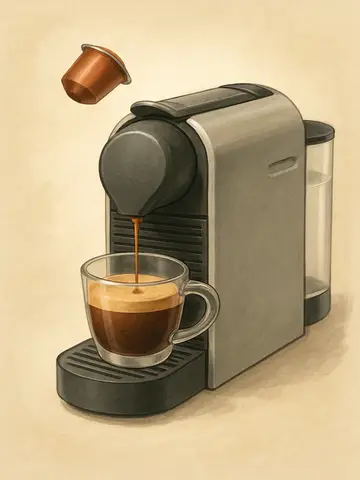
In 1986, Nestlé launched the Nespresso machine, invented by Éric Favre. This innovation has revolutionized the coffee market by combining sealed capsule technology with high pressure extraction. The system ensured constant quality and ease of use, which quickly attracted professionals and individuals. In the short term, Nespresso has created a new consumption segment: serving coffee. In the long term, this invention has profoundly altered purchasing behaviour, promoting the rise of premium coffee, personalization and rapid consumption, while stimulating the development of competing machines and a globalized trade in capsules. The success of Nespresso is part of the continuation of the culinary innovations of the post-war period, such as the popularization of the expresso in Europe ( 1950s), the rise of simplified appliances (1970s) and the rise of individualized and nomadic consumption in the 1990s-2000s.
Nespresso's invention in 1986 marked a major break in the coffee industry, combining technology and marketing to transform a centuries-old habit into a global phenomenon, paving the way for contemporary changes in coffee consumption.