


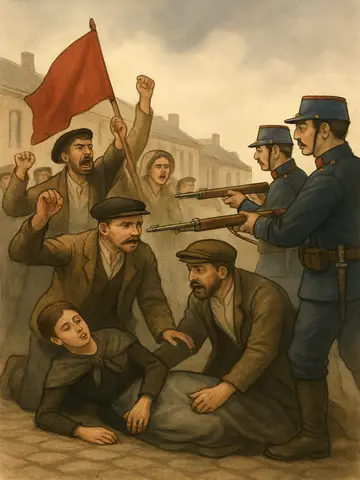
The Fusillade de Fourmies, which occurred on 1 May 1891, remains a major event in French social history. On that day, in the small industrial town of Fourmies, a peaceful demonstration organized by workers demanding the eight-hour day turned into a drama when the army opened fire on the crowd. This tragedy profoundly marked the workers' struggle in France and symbolized the growing tensions between workers and authorities at the end of the 19th century.
Social and political context of the Fusillade de Fourmies
At the end of the 19th century, France experienced rapid industrialization, accompanied by an explosion of the workers' movement. Working conditions are extremely harsh: excessively long days, low wages and lack of social protection. In this climate, demands for reduced working time, especially the eight-hour day, are increasing. May 1 became an international symbol of the workers' struggle. At the same time, the government and the law enforcement agencies remain very suspicious and even repressive in the face of these mobilizations, which call into question the established order. Fourmies, a textile town in the North, is an important focus of this social challenge.
Tragedy of 1 May 1891 at Fourmies
On May 1, 1891, several thousand Fourmies workers gathered to claim the eight-hour day. The demonstration, first of all peaceful, attracts the attention of local authorities, who fear overflows. When the demonstrators advance to the main square, the soldiers stationed to frame the demonstration suddenly open fire. Nine people were killed instantly and dozens were injured. This massacre deeply shocked public opinion and provoked a wave of indignation throughout France and beyond. The Fourmies shooting quickly became a symbol of the brutal repression of the workers in struggle.
The Fusillade de Fourmies remains a key moment in the history of the French labour movement, illustrating the violence of social conflicts at the end of the 19th century. It helped to strengthen the determination of workers to obtain better conditions and accelerated the recognition of trade union rights. Today, this tragic event is commemorated as a reminder of the struggle for social justice and the importance of respect for fundamental freedoms.