

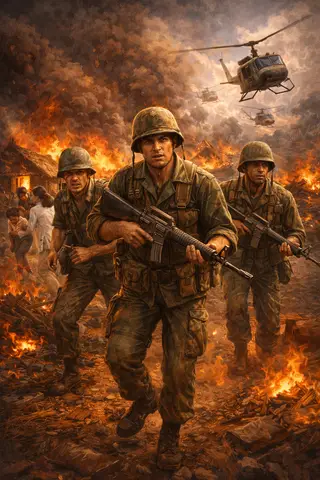
The Vietnam War, a major conflict of the 20th century, has profoundly affected the history of the country and the world. Although the conflict lasted many years, its official starting point was often in 1955, a pivotal period that saw the rise of tensions between the Communist North and the South supported by the United States. Understanding the historical context and early confrontations of this era is essential to grasp the magnitude and complexity of this conflict.
Historical context of the beginning of the Vietnam War
The Vietnamese conflict has its roots in the French settlement in Indochina and the subsequent struggle for independence. After the French defeat at Dien Bien Phu in 1954, the Geneva Accords divided Vietnam into two distinct entities: a Communist North led by Ho Chi Minh and a South supported by Western powers, including the United States. This division, which is supposed to be temporary, quickly widened a political and ideological gap. In 1955, political instability in the South, combined with the American will to prevent the spread of communism in South-East Asia, led to an intensification of tensions, laying the foundations for a major armed conflict.
The first confrontations in 1955 in Vietnam
The year 1955 was marked by the first skirmishes and confrontations between the forces of South Vietnam, led by Ngô ▼ình Di Dijm, consolidating his power with American support, undertook to suppress communist movements in the South. Those measures had led to an escalation of violence, particularly in rural areas where Viet Cong was gaining influence. The incidents of 1955 still represented only local conflicts, but they already announced a total war that would last almost two decades, involving many international powers.
The beginning of the Vietnam War in 1955 is a key moment in revealing the deep divisions and geopolitical stakes of the Cold War. This conflict, which began with limited political tensions and confrontations, would rapidly intensify to become one of the most emblematic and devastating conflicts of the twentieth century. Understanding these first steps allows us to better understand the human, social and political consequences that have affected Vietnam and the world.