

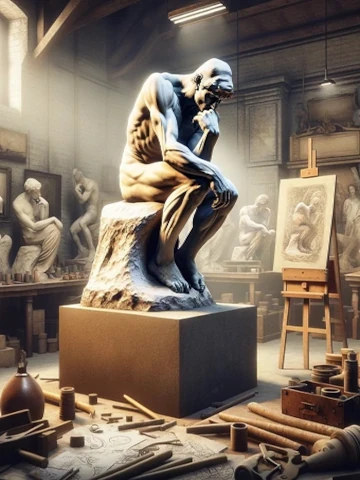
Sculpture The Thinker, created in 1881 by Auguste Rodin, became an emblematic work of modern sculpture. Representing a man immersed in deep reflection, this statue embodies both the intellectual power and the complexity of human emotions. Back to the origin and artistic realization of this major work.
The origin and inspiration of sculpture The Thinker
The Thinker its origin in a larger commission entrusted to Rodin for a monumental portal for a museum of decorative arts, called The Gate of Hell. Inspired by The Divine Comedy This work was to represent human torments and passions. The figure of the Thinker embodies Dante himself, meditating on the infernal scenes that surround him. Rodin thus sought to translate not only suffering, but also the intense reflection that precedes the crucial choices of existence. The work thus symbolizes the power of thought in the face of the chaos and complexity of the world.
Rodin's artistic creation in 1881
In 1881, Rodin sculpted The Thinker in an innovative style, combining realism and expressionism. It accentuates the tense muscles of the character to show mental as well as physical effort, an approach never before seen at the time. The man is seated, the chin leans on one hand, the body folded on itself in a position both static and vibrant energy contained. Rodin uses bronze to give life to this sculpture, exploiting matter to strengthen texture and anatomical details. The Thinker Thus became a universal symbol of meditation, a tribute to the human capacity to think and question.
The Thinker Rodin, created in 1881, far exceeds his initial function as an integral part of a portal. He established himself as a timeless icon of art and human thought. Through this work, Rodin was able to capture the inner complexity of man, making the Thinker a universal figure of introspection and existential questioning. Even today, this sculpture continues to inspire and fascinate art lovers around the world.