

The construction of the Berlin Wall in 1961 remains one of the most significant events of the Cold War. Symbolizing the ideological division between the communist East and the capitalist West, this physical barrier has profoundly transformed the political, social and human landscape of the city. A review of the historical context of this construction and its immediate consequences for the life of Berliners.
The construction of the Berlin Wall in 1961: historical context
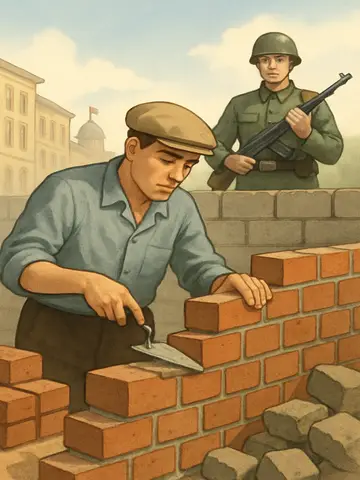
In August 1961, the German Democratic Republic (RDA) decided to close the border between East Berlin and West Berlin abruptly by erecting a separation wall. This initiative comes after several years of growing tensions between the East and West blocs, as well as after a massive exodus of citizens from East to West, seeking better living conditions. The construction of the Wall is therefore a drastic step to stop this flight and to consolidate the control of the communist regime over East Berlin. At the international level, this act also symbolizes the deep division of Germany and exacerbates rivalries between the great powers, marking a hardening of the Cold War.
Immediate impact of the barrier on Berlin life in 1961
The erection of the Wall instantly upsets the daily life of Berliners. Families and friends are suddenly separated, often overnight, without the possibility of communication or visits. The Wall transforms the city into a fragmented space where freedom of movement is severely restricted. At the social level, this division creates a climate of fear and uncertainty, with military patrols and strict controls along the border. The human impact is immense: dozens of people try to cross the barrier, sometimes at the risk of their lives, illustrating the distress and deep desire for freedom in Berlin. Thus, the Wall quickly becomes the visible symbol of not only geographical separation, but also ideological and human separation.
The construction of the Berlin Wall in 1961 marks a decisive turning point in the history of the Cold War and the city itself. More than just a physical barrier, it embodies the deep fracture between two antagonistic worlds. While its fall, almost 30 years later, was celebrated as a triumph of freedom, the years following its construction remain a poignant reminder of the suffering caused by the Berlin division.