


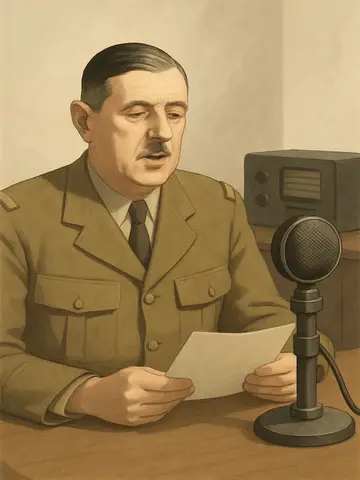
The Call of General de Gaulle of 18 June 1940 is a founding moment in the history of contemporary France. As the country had just suffered a resounding military defeat against Nazi Germany, General de Gaulle launched a message broadcast from London, urging his fellow citizens not to lose hope and continue the struggle. This speech, although little listened to at the time, became the symbol of the French Resistance and the determination to regain freedom.
The historical context of the appeal of 18 June 1940
Following the rapid and devastating invasion of France by German troops in May and June 1940, the French government led by Marshal Pétain decided to request the Armistice, signed on 22 June 1940. Faced with this official surrender, General Charles de Gaulle, then Under-Secretary of State for War, refused to recognize this decision. Exile to London, he used the BBC to broadcast a call to resistance, inviting French soldiers and citizens to continue fighting alongside the Allies. This speech, delivered in a context of despair and chaos, marked the beginning of free France and opened a new path for those who refused submission to the occupant.
The lasting impact of the call by Gaulle on the French Resistance
Although the appeal of June 18 was not widely heard at the time of its broadcast, it quickly acquired a major symbolic meaning. This message became the rallying cry of the free French forces and the Internal Resistance, uniting various movements under the same banner of fighting against occupation and collaboration. De Gaulle became the leader of free France, and his call embodied the spirit of a nation that refused to disappear. Even today, this call is commemorated as an act of courage and patriotism, illustrating the unwavering determination of a France to rise up against adversity.
The Appeal of 18 June 1940 remains a pillar of French collective memory, symbolizing not only armed resistance, but also hope and faith in a better future. By this simple radio message, General de Gaulle was able to rally a divided nation, laying the foundations for the liberation and restoration of the Republic. More than just a speech, this call is a lesson of commitment and perseverance that continues to inspire present and future generations.